05 January 2009
Mutiny Time?
Before pitchers and catchers report to Disney's Wide World of Sports complex on Feb. 14, it appears Wren will be more likely to upgrade his starting rotation with the acquisition of Jon Garland or Andy Pettitte.
Pettite's fine, as I have already mentioned, but if Wren gets Garland, I will mutiny. I don't send emails to companies complaining about not having something, discontinuing something (EA Sports still needs to re-start their MVP Baseball video games), etc., but I will send one to Frank Wren about Jon Garland (probably just a copy and paste from this post). There is no good reason to get him, but he's been mentioned too often around the Braves' search for a starter to make me think it's not legitimate. He might be cheaper, but being cheaper doesn't mean he'll be worth anything. If we are just re-building and need a cheap option to throw out there, any of the minor-leaguers would probably be better. Don't do it, Frank.
Also, the article notes:
There's still absolutely no indication that the Braves are interested in revisiting trade talks for Peavy. As for Derek Lowe, it appears they may show more interest in him if his cost drops and he's willing to pitch for an annual salary of approximately $12 million.
Why on earth are you willing to spend 5 years and $80M on Burnett but not on Lowe? Age pretty much counts as injury issues, right? So, if you could get Lowe for 3/48 or 4/64, shouldn't you do it? I agree that 5/80 is probably too much, but the other two aren't necessarily. But I guess the Braves front-office knows something we don't. However, I refuse to believe they know the special cure for Garland's suckiness.
04 January 2009
Christy Mathewson
373-188__434 CG__79 SHO__2502 K__2.13 ERA__135 ERA+__1.059 WHIP
2 Triple Crowns (1905, 1909)
2 No-hitters
Christopher Mathewson was born August 12, 1880 in Factoryville, Pennsylvania. He would go on to Bucknell University and play on both the football and baseball teams. Mathewson left college and signed with a team from the New England League before the New York (Baseball) Giants purchased his contract. Initially, he failed to live up to expectations, so the Reds selected him in the next Rule V draft (which was a better selection -- Mathewson or Johan Santana?) and then traded him back to the Giants.
Mathewson employed a good fastball and a new pitch -- the screwball -- during his 17-year career. One of the best stories about Mathewson is the 1905 World Series against the Philadelphia Athletics. He pitched a 4-hit shutout in Game 1 for the win. Then, he came back three days later to throw another 4-hit shutout. To top it all off, he came back two days later and twirled a 6-hit shutout to clinch the series.
Mathewson had a great career in New York, but he didn't do it on Sunday. He had a religious conviction against pitching on the Sabbath and may have been a reason he was called the "Christian Gentleman". When he did pitch, he was great, and he even had a brother that pitched alongside him. Henry and Christy won the most games by brothers on a single team with 373. Christy won 373 of them, and Henry won all of 0.
The Reds would take him back for his last game in the majors on September 4, 1916. That game pitted him against his old foe Mordecai "Three Finger" Brown. Mathewson threw a complete game but gave up eight runs in his final victory. He would manage the Reds for the next two seasons until he enlisted in the Army for WWI along with Ty Cobb.
Along with Cobb, Babe Ruth, and Honus Wagner, Mathewson was elected to the Hall of Fame in 1936 with 205 votes.
03 January 2009
Derek Lowe
Lowe was excellent this past season. He was 14-11 with a 3.24 ERA in 211 IP. His GB/FB rate of 2.63 is stellar, but it was well below his career 3.32 and his 3.38 of 2007. His K/9 of 6.27 was above his career 5.91 but below his 6.64 from 2007. Neither of the two should scare anyone. He'll likely see his groundball rate climb back closer to 3, and even if it doesn't, it's good enough to keep him successful regardless. The strikeout rate is fine. What I worry about is the walk rate. It was an astounding 1.92 last season, but that is way down from his career 2.53. The previous season saw him walk 2.66 every nine innings. He's due to see that jump back to his career norm (an interesting side note -- he threw first pitch strikes 59.2% of the time, which is around his career norm, so why did he walk so few people?). His FIP last season was 3.26, so he didn't get lucky from having a good defense. And, his last two seasons saw him have FIP's of 3.97 and 3.68. He should be closer to those next season. His HR/FB rate of 9.5% is a little low, and it will probably go up next season (maybe even way up if he goes to Philly).
Lowe will be 36 next season, so teams are understandably concerned about his age. But, he's been very durable and successful. I'd like to see the Braves try to grab him for 3 years/$58M. It's a lot of money, but the Braves have enough. If the money kept the number of years to three, I'd like the deal. I'm sure the Mets and Phillies (maybe less so for the Phillies) would like that as well. More years would probably be a bad idea. After three, he'll be 38 at the end. He probably won't be an ace at the beginning of the contract, and therefore, I don't think he'll be one at the end. The Mets initial offer was probably low because they thought they were the only ones involved. Then again, they may be the only ones involved anyway, considering the lack of veracity in the rumor mill lately.
The Off-Season So Far
1) Less spending. This is a common theme among writers right now. After the weeks following the Winter Meetings, things still have not taken off. Teams aren't making a lot of trades as they want to hold onto prospects and keep costs down. They aren't buying up free-agents like they used to. But why is it? Certainly, the economy has played a part, but how much? Are teams really that squeezed that they can't spend on free-agents? With some teams still spending and raising payrolls, I'm not entirely convinced. Could it be just that teams are learning the free-agent game? Relievers used to get huge contracts, but have stats analysis and experience finally taught teams to spend better? And now, this smarter spending and poor economy is all coincidental? Or did the economy spur the smarter spending, and when it works out, will it become a precedent for future spending/negotiations? Or will free-agent spending go back up once the economy gets better? I know it seems like the Yankees are the only teams willing to spend, but the Orioles and Nationals would have dropped a lot of money on Teixeira as well.
2) Older players aren't getting any play. This seems to have really taken off last season with the Mitchell Report, and it has followed through this off-season. People are scared off of players past the age of 33-35, and even players of those ages. But why? You can talk about how steroids and amphetamines helped aging players stay young. But Ty Cobb hit .401 at 35 and .378 at 38. Stan Musial hit .330 at 41. Joe Morgan hit .289 at 38. Babe Ruth hit 34 HR at 38. Mike Mussina was just great at 39. Steve Carlton had a 3.11 ERA at 38. Players have always been able to succeed after their primes. Are teams just being too pessimistic thinking that the drugs were the only reasons for their success? Then comes the biggy -- did the drugs have anything to do with the players' success anyway?
3) Will players still get their money? The longer things drag out, the more you wonder just how low salaries for guys are going to get for next year. Is Ben Sheets going to have to take $5M to pitch next season or will he still get something closer to 3/$36M? Is Adam Dunn going to get his $13M a year or will he have to settle for 9 or 10? Will there really be bargains or will guys still get a lot per season but maybe with fewer years than usual? And again, does this have to do with the economy or are teams just getting smarter with their money?
4) What happened to Derek Lowe being the most sought-after pitcher after Sabathia? It seemed like Derek Lowe was number 1 on many teams' lists at the end of the season, but he is still waiting while Sabathia, Burnett, and Dempster have already signed. As of now, it really only seems like the Mets, Phillies, Red Sox, Brewers, and maybe the Braves are interested, and only the Mets and Phillies seem legitimately interested. Is this because people were initially excited, but after considering his age and demands, they became less so? Or were the never really that interested and the media drummed up all the attention?
5) How long will the focus on defense last? If Tampa and Seattle have bad seasons, will teams look at that and say that they prove defense isn't as important? If they both succeed with less-than-stellar offenses, will it change the game? History is often cyclical, and defense could once again reign, at least until someone proves that a massive offense can offset a bad defense. Will teams have the patience to watch the Adam Everetts and Endy Chavezes hit .250 but play stellar defense but give them a lot of at-bats? Will we criticize them for letting them have those at-bats even if they're playing great defense?
Honus Wagner
.327/.391/.466/.857__1736 R__3415 H__640 2B__252 3B__101 HR__1732 RBI__722 SB__150 OPS+
Johannes Peter Wagner was born February 24, 1874 in Philadelphia, Pennsylvania. During his childhood, his mother called him "Hans", and that would later evolve into his more popular nickname "Honus". Even though he was the most famous of his brothers by the end, it was actually his brother Albert who got him his first tryout.
Wagner began his successful career as one of the greatest shortstops of all time with the Louisville Colonels (Louisville!), but after his second season, the league contracted and the Colonels were gone. The Colonels owner, however, bought half of the Pittsburgh Pirates and brought many of his players, including Honus, with him after the 1899 season.
Pittsburgh proved to be a beneficial place for Wagner. He won a batting title in his first season and won a World Series in 1909. That World Series almost did not happen, however. After the 1907 season, Wagner retired, but the owner offered $10,000 to Wagner. Wagner accepted and was the highest paid player for many seasons, and due to this, some wonder if his retirement was just a ploy for a raise (these were the days before a union). Wagner would later become the second player in history with 3,000 hits (Cap Anson being the first). Like other players of the time, he became the manager of his team, but after 5 games, he told the owner that the position wasn't right for him. After the 1917 season, Wagner retired.
One of the greatest shortstops and even players of baseball history, Wagner was an easy choice for the inaugural Hall of Fame class of 1936, and he tied Babe Ruth's 215 votes. Bill James rates him as the second greatest player of all-time behind Ruth, and he makes many people's all-time lists as the top shortstop.
The "Flying Dutchman" was known for his speed and defense. What he may be best known for now is his T206 baseball card. He, supposedly, didn't want his picture and image used as a baseball card in a cigarette box, and the American Tobacco Company had to stop making them, which in turn made the card extremely rare. In 2007, the card sold for $2.8M and became the most valuable card ever.
02 January 2009
Joe Mauer Has Kidney Surgery
Babe Ruth
.342/.474/.690/1.164__2174 R__2873 H__506 2B__136 3B__714 HR__2217 RBI__207 OPS+
94-46__107 CG__17 SHO__2.28 ERA__122 ERA+
2 All-Star games (1933, 1934)
1 MVP award (1923)
Born February 6, 1895, George Herman Ruth was born in Baltimore, Maryland, but he spent most of his early life in St. Mary's orphanage because his parents worked too much to take care of him. At St. Mary's, a brother taught Ruth how to play baseball, and it was there that Ruth was discovered.
With needing to say so, Ruth's playing career was astounding, both on the mound and crushing pitches from it. He began his career with the Boston Red Sox as a pitcher, but his anger and self-discipline issues would become a factor in him being dealt to the New York Yankees. By 1918, Ruth's hitting prowess enticed the Red Sox into putting him in the lineup on a more regular basis. Ruth himself wanted to hit more, and he gradually stopped pitching. In his last season as a Red Sox (1919), he set a regular-season home run record with 29. It would also be his last season as a Red Sox.
After the 1919 season, Ruth demanded a raise to $20,000 (double his previous salary), and after negotiations failed, owner Harry Frazee looked to trade Ruth. The White Sox offered Shoeless Joe Jackson and $60,000, but the Yankees offered $100,000. Ruth signed a contract, on which the trade was contingent, and became a Yankee. As a Yankee, Ruth shifted to the outfield on a permanent basis and became the symbol of a changing style of baseball, in which power had a place. When the team moved from the Polo Grounds to Yankee Stadium, Ruth fittingly hit the first home run in the "House that Ruth Built". He would go on to break and re-break his home run record, and reportedly after hitting his 60th in 1927, Ruth shouted, "Sixty, count 'em, sixty! Let's see some son-of-a-bitch match that!" By 1934, however, even Ruth began to decline, and due to his quarrells with manager Joe McCarthy, the Yankees sold Ruth to the Boston Braves, who hoped Ruth could bring in much-needed attendance. However, besides an initial spike in attendance, Ruth did little else for the Braves and retired May 30, 1935.
A remarkable career led to Ruth being inducted into the inaugural Hall of Fame class of 1936 with 215 of 226 votes (second to Ty Cobb). Ruth prowess led to several phrases and adjectives. "Ruthian" describes something done with great power, reminding baseball fans of his 500-foot blasts. "The Babe Ruth of ____" describes that ____ is the best player or person doing whatever he/she does, implying Ruth was the best baseball player that ever lived. Indeed, he may have been.
Off the field, he was well-known for his exploits, with alcohol and women. On the field, he had several outbursts and was known to throw dirt on umpires as well as take a swing at them and fans.
A common mistake is to believe that the candy bar "Baby Ruth" is named after Babe Ruth. However, it is named after Grover Cleveland's daughter, the first and only born in the White House, Ruth.
01 January 2009
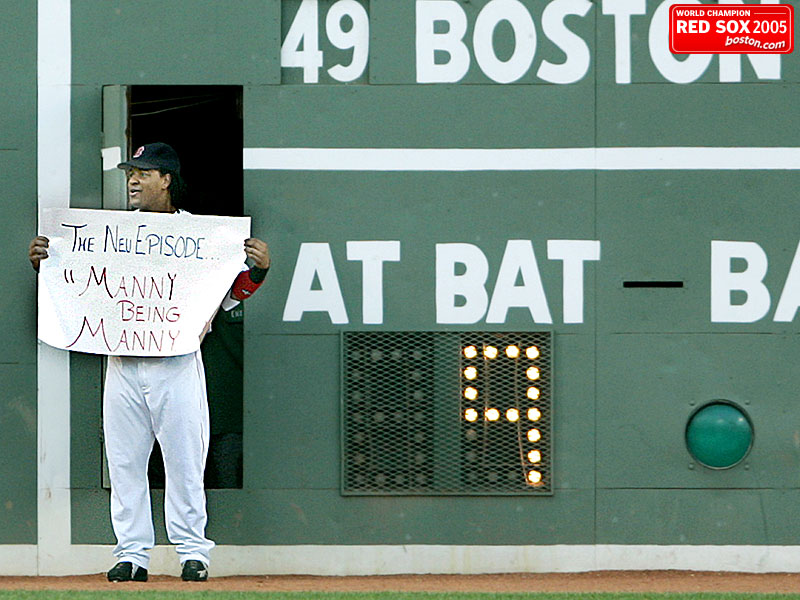
Giants Getting in on Manny?
The Giants, the NL West's most active team this winter, are quietly making an aggressive play for free agent Manny Ramirez, according to a major-league source.
A few thoughts:
1) Sabean just can't keep his hands off old players with track records.
2) Barry Bonds II.
3) This would make the Giants the favorites in the NL West.
4) The Giants could be that Wild Card team Boras always banks on and always gets.
5) This would be a double shot at the Dodgers. One, the Giants just took away the Dodgers best player from right under their nose. Two, Manny will get to prove 19 times why Coletti should have paid him the money. There's motivation for you (well, for at least one season).
6) This could just be a negotiating ploy set up by Boras to get leverage against the Dodgers by threatening 5).
Ty Cobb
Career stats:
.366/.433/.512/.945__167 OPS+__4189 H__724 2B__295 3B__117 HR__1937 RBI__2246 R__892 SB
Triple Crown in 1909
1 MVP Award (1911)
Tyrus "Ty" Raymond Cobb was born on December 18, 1886, and he played from 1905 to 1928. When Cobb went out to try for a semi-pro team, his father told him, "Don't come home a failure." In August of 1905, he was sold to the Detroit Tigers, but in the same month, his mother killed his father. Supposedly, his father suspected his mother of infidelity and snuck past his own window to try to catch her, but his mother thought he was an intruder and shot him. Cobb would later attribute his play to the memory of his father saying, "I did it for my father. He never got to see me play ... but I knew he was watching me, and I never let him down."
Cobb's playing career was obviously remarkable. At age 20, he became the youngest to win a batting championship until Al Kaline did it in 1955 while a day younger. He apparently cherished winning batting titles so much that he sat out to preserve his average and played mind games with Shoeless Joe Jackson. Cobb also set the single-season stolen base record by stealing 96 bases, which stood until Maury Wills broke it. This style of play caused Cobb to resent the up-and-coming Babe Ruth who hit home runs and refused to be the hit-and-run player Cobb was (Cobb also hated Ruth's lifestyle), and in order to prove himself, Cobb decided to swing for the fences for a series. In one series, he hit 12 of 19 with five home runs and 29 total bases. Ruth responded by saying, "I could have had a lifetime .600 average, but I would have had to hit them singles. The people were paying to see me hit home runs." In 1921, Cobb would become a player/manager, but he was never really liked and was never really successful. Later that season, he became the youngest and fastest (in at-bats) to 3,000 hits, both records are still intact.
He retired after the 1928 season having hit at least .300 for 23 consecutive seasons, an amazing record not likely to be broken. A dead-ball era legend, the "Georgia Peach" is arguably the best player in baseball history. He received the most votes (222 of 226) in the inaugural Hall of Fame class in 1936.
Off the field, Cobb had a violent temper and was an unabashed racist (albeit, he lived in a much different time with much different values). He stabbed a black man for being "uppity" and choked a black woman when she tried to defend her husband. Cobb also fought with an umpire underneath a grandstand after a game, and the fight was only broken up after Cobb knocked the man down and began to choke him. At the end of his life, Cobb, however, seemed to see some of the error of his ways and supposedly told Joe E. Brown, a comedian, that he regretted having no friends at the end of his life. Cobb died on July 17, 1961.
30 December 2008
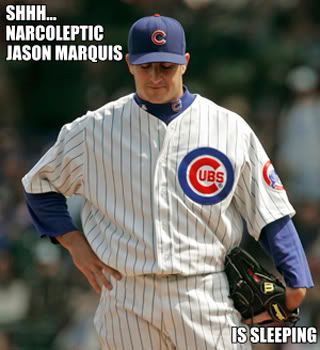
Rockies Like Marquis?
The Rockies have a surplus of right-handed relievers and they long have had interest in Marquis, a sinker-baller who is 3-0 with a 2.51 career ERA at Coors Field. The team also had pursued free-agent right-hander Tim Redding, who is looking for a two-year contract.
I won't get into a detailed discussion on this because it boils down to a bad starting pitcher being traded for an erratic reliever, both of whom are being paid much more than they are worth. However, I have some nagging questions about this. One, are the Rockies really going to trade for Marquis based on 5 games and 28.1 IP in Coors Field when the rest of his body of work at more pitcher-friendly ballparks (Shea Stadium- 4.80 ERA in 8 starts, for instance; but anywhere other than Coors is more pitcher-friendly -- career ERA of 4.55 and FIP of 4.94 , it had to shoot up somehow) shows he's a bad pitcher, especially considering the price tag? Two, for Marquis' reputation as a sinker-baller, his career 1.50 GB/FB isn't that impressive. Lowe (3.32) and Webb (3.57) are more indicative of being groundball pitchers (granted, they are the best, but it would take something north of 2 to probably make any sort of real difference when considering Coors). 1.50 is nice, but I'm not sure it's going to make much of a difference at Coors for a season. Webb or Lowe might be able to overcome Coors, but not Marquis. This would be a clear win for the Cubs, moving salary and getting a decent reliever. Okay, maybe not clear, but I really don't see the upside for Colorado. Not that Tim Redding is better, but at least, he's cheaper.
And yes, I realize this may not happen, and for my opinion of the Colorado front office, I hope they don't do it.
Jim Rice vs. Dale Murphy
I'm probably late on this discussion, but I'm glad I've been educated and hope I've educated some others.Another thing that's really helped Rice is the attachment of the word "feared" to his name. Unfortunately, nobody's able to come up with one word for Dale Muprhy. Here are four, though: "Better than Jim Rice."
I really haven't looked too much at Jim Rice, and I'm not qualified to judge his Hall of Fame candidacy (I really need to spend some time combing through Hall stats and such). But it is an interesting question. These are two similar players in that you repeatedly hear, "He was a good power-hitter for a number of years. He didn't walk much, but he was a great hitter nonetheless." Yet, Jim Rice is excused and Dale Murphy is criticized and not seemingly welcome in the Hall discussion. Let's take a look at the two (all of these are career numbers):
Years played --> Murphy 1978-1991; Jim Rice 1975-1989
I use the full seasons here for really no reason other than being fair. Regardless of whether it's fair or not, it establishes that they played at the same time and can't have any "different era" questions. I'm just making sure of this before we start, not that I don't think you know this already. Everything else has the entire career numbers.
Batting average --> Murphy .265; Rice .298
Rice wins by a healthy margin here. A career .300 hitter is pretty impressive.
On-base percentage --> Murphy .346; Rice .352
Rice wins again, but I think we can call this a draw. However, the difference between BA and OBP for the two shows Murphy was much better at drawing walks. Why is it that people say he was a hacker?
Slugging percentage --> Murphy .469; Rice .502
Rice healthily wins again. He seems to have hit the ball harder than Murphy. I doubt Fulton County was a harder place to hit than Fenway.
On-base plus slugging --> Murphy .815; Rice .854
Rice wins again, but I think you could have figured that one out. I just figured I would mention it.
OPS+ --> Murphy 121; Rice 128
More support for Rice, but he didn't win by a whole lot.
Doubles --> Murphy 350; Rice 373
Rice hit more and in fewer seasons.
Home runs --> Murphy 398; Rice 382
Murphy actually won one, but Rice did it in fewer seasons. I guess this one is a bit of a draw and may still favor Rice.
Stolen bases --> Murphy 161; Rice 58
Murphy tripled Rice in this category, and before people ask about caught stealing, Murphy had 68 while Rice had 34. Murphy was a better base stealer and did it more often.
Runs --> Murphy 1197; Rice 1249
Rice wins again and in fewer seasons.
Runs batted in --> Murphy 1266; Rice 1451
Ditto from above but more exaggerated.
All-Star appearances --> Murphy 7; Rice 8
Rice still winning.
MVP awards --> Murphy 2; Rice 1
Murphy wins one.
Gold Gloves --> Murphy 5; Rice 0
Ouch. And here's one of the big points against Rice -- his defense. He never seems to have been a good defensive player. Murphy, however, was a good defensive player and won quite a few Gold Gloves. We can argue about the validity of those Gold Gloves, but I think it ends up representing how good you are in the end. In this case, Murphy was significantly better. Now, how much do we value this defense? Is it just another category like home runs and runs and doubles? I think it warrants more value than that. Rice was only a positive influence on one side, whereas Murphy was on both sides. This may be (although I don't know for sure) the key to Neyer's argument. Without it, Rice and Murphy are similar offensive players with Rice being a bit better.
Silver Sluggers --> Murphy 4; Rice 2
Murphy wins, although I'm not really sure what this means.
Home Run Crowns --> Murphy 2; Rice 3
This is about even. Rice may have been more feared, but Murphy did his damage as well.
RBI Crowns --> Murphy 2; Rice 2
Ditto from above.
An interesting note: as similar as the two are in numbers, they aren't a similar batter in Baseball-Reference and only share Duke Snider and Ellis Burks.
So who's better? Offensively, Rice is a little better considering he produced his stats in fewer seasons, but honestly, they are eerily similar. Defensively, however, there seems to be no contest. Murphy seems to have been a much better defender than Rice, and that should count for something. Again, I'm not qualified to judge either's candidacy, but if Rice gets in, I think Murphy should be coming in right behind him, if not before. If only because we've become more educated on the value of good defense, even if we can't quantify it.
Nice call again, Mr. Neyer (can I call you that?).
Marlins Want Turnbow?
In 2005, Turnbow was amazing. He had a 1.74 ERA in 67.1 IP with 39 saves in 43 chances and seemed to be on the verge of becoming on of those hot, young closers we like so much. His K/9 was 8.85, and his BB/9 was even a respectable 3.21. Even then, some warning flags should have popped up. His FIP was 3.20 (1.50 over his ERA), his walk rate was pretty low for a guy who had shown himself to be quite wild (this could have been just Turnbow getting better but now we know better), and his BABIP was .259. Since, his K/9 went up over 11, but his BB/9 went over 6. In 2008, he had a rotator cuff injury that limited him to 6 games, but he didn't need injury. So, the Marlins are possibly going to trust a guy with shoulder injuries and a wild tendency to be a cog in their bullpen. Considering he has received quite a bit of attention, he'll likely get a major-league deal (and has received one from the Giants).
Instead, the Marlins could have kept Joe Nelson, who had 2.00 ERA in 54 IP with a K/9 of 10 and a BB/9 of 3.67. The previous season, Nelson had a 4.40 ERA with an 8.87 K/9 and 4.43 BB/9. His talent level is probably closer to the latter considering his FIP's of 4.31 and 3.45, but that's still as good as Turnbow's without the immediate injury scare.
So why are the Marlins choosing Turnbow when they could have just re-signed Nelson? Don't say age (Turnbow is 31; Nelson is 34) because a one-year contract for a reliever isn't an age risk and three years isn't that much of a difference. The difference, in the end, may just be about money. Nelson was able to receive $1.3M from the Rays, and it is likely he would have received about that much in arbitration. Turnbow probably won't top a million and will probably get about $800K. Is 500K that much of a difference that you would seemingly sacrifice so much? Granted, they are just relievers, and I have said repeatedly that relievers are volatile. But Nelson seems a much better bet talent-wise and injury-wise, doesn't he? If they give Turnbow more than Nelson got, I'll have some more serious questions.
29 December 2008
I Was Right ... Sort Of
“There are a lot of rumblings that all the teams know exactly what everyone is doing with free agents,” one prominent agent said ...
But agents acknowledge that the clubs have a ready-made excuse, or cover, for not acting as they have in previous years: the economy.
“There’s continuing pressure for teams to cut their budgets,” an agent said. “Teams that intended to be aggressive had to cut back because budgets have been lowered.”
I said it about a month ago, partly in jest partly not. I doubt that baseball GM's are really colluding at all. The economy has caused them to react/overreact and be more careful when spending their money. This is more how they probably should spend their money. As a result, free-agents aren't getting the money they used to get. As for all the rumors, A) not every team is floating rumors (don't you need all or most for collusion?); B) there are always rumors; C) there are a lot of rumors, mostly conflicting. I'm not convinced, but I'd like to say,"I told you so." And when I'm wrong, someone please throw that back in my face.
28 December 2008
Penny to Boston
After the Yankees threw millions at their rotation, the Red Sox only threw a Penny at theirs. Okay, that was bad, but you know I can't resist cheesy puns. Anyway, I said a few months ago that someone should take a gamble on Penny, and it appears as though the Red Sox are. A few quick thoughts:
1) If Penny (only 31 next season) comes back and pitches somewhat near his pre-2008 performance, he could be a mid-3 ERA pitcher. His FIP's the previous five seasons consistently sat in the 3.59-3.92 range. Adding him to Matsuzaka, Beckett, and Lester would make a devastating rotation. Without him, that's still a really good rotation.
2) Does this mean the Red Sox are going to trade one of the young pitchers (like I said to earlier)? Because otherwise, they're just being selfish.
3) Seriously, is this an indication another deal is in the works, but they just needed Penny to make sure they could take the gamble? Then again, Penny in himself is a gamble. Hmmm ...
4) Who is the best injury-proned pitcher next season -- Sheets, Penny, or Burnett?
Quick Note on Poll
Oh, and the Lions lost. :)
Why Hasn't This Happened Yet?
It makes so much sense in baseball terms.
The Red Sox need a catcher, preferably a young one to plug in with all the young players in the lineup or soon to come. Jason Varitek is gone, and the Red Sox seem to be holding out as long as they can, unknown is whether this is trying to find an alternate solution or just trying to get Varitek's salary demands to come down (maybe even a bit of both). Even if they want both, getting a good, young catcher would give the Red Sox more leverage in discussions with Varitek.
The Rangers always need pitching. Sure, their system is glutted with a bunch of pitching prospects, but you can always use more, especially of ace-quality. Kevin Millwood and Vicente Padilla will be gone next season, and adding one of Boston's quality pitching prospects gives the Rangers more options.
It makes organizational sense.
The Red Sox have one of the most plentiful farm systems in baseball, and pitching is a big reason why. Clay Buchholz, Michael Bowden, Casey Kelly, Nick Hagadone, Daniel Bard, Stolmy Pimentel, and newly-acquired Junichi Tazawa are all very solid to excellent pitching prospects. They could afford to give one or two up in exchange for a young catcher, something they do not have in their system. The big issue is that the Red Sox don't want to give up the one with the highest potential -- Clay Buchholz --, who could be an ace one day. That's the one the Rangers want, understandably.
The Rangers also have one of the best farm systems in baseball, and catching is their major surplus with Max Ramirez, Taylor Teagarden, and Jarrod Saltalamacchia all ready for a major-league job. Trading one leaves two for the Rangers to platoon or leave one in AAA for more experience. Teams always like young pitching, and considering the Rangers had the worst ERA in baseball last season, they need pitching badly. The big issue is that they want value in return for either Jarrod Saltalamacchia and Taylor Teagarden, who have the most upside. One of those is who the Red Sox want. Saltalamacchia seems to be the one of particular interest, but I think a straight-up trade of Teagarden for Buchholz makes too much sense not to get done.
It makes financial sense.
Both are young players who have at least five years of control left (I actually think both have six left, but I'm trying to be cautious).
It makes talent sense.
Clay Buchholz is an ace-quality pitcher. He has the tools to be the next great pitcher, and has even shown it by throwing a no-hitter. He, however, had some issues last season and regressed due to losing command of his fastball and a subsequent lack of confidence. This off-season, he pitched well in Fall Ball and should be ready to resume his major league career next season.
Taylor Teagarden is an amazing, young catcher. Those are arguably as hard to find as young aces. He can hit and play defense. How many of those do you find? Not many. Last season, he had an incredible final month that really put him on the map with an OPS over 1.000. He, however, cannot be counted on to repeat that for an entire season, but it shows that he is capable of really hitting at the major-league level.
So why isn't this done yet?
First, teams don't like to trade high-end prospects straight up. You spend all the time, energy, and money into developing a sure-fire major leaguer, and you don't want someone else realizing the benefits. Prospects are prospects, and you don't want to be caught on the wrong side, where the prospect you receive fails and the one you gave up succeeds.
Second, it's a battle of wills. My guess is that both teams would like to make this trade, Buchholz for Teagarden. As I said, it makes a lot of sense. Each team, however, wants to "win" this trade. Why give up Buchholz if you can get Teagarden for Bowden (a little less talent than Buchholz)? Why give up Teagarden if you can get Buchholz for Saltalamacchia (more undeveloped than Teagarden but may have more upside)? So, the teams are stuck trying a Bowden for Saltalamacchia deal. The problem is those are not the players the other teams want. So, they're trying to make the other bend first.
Finally, there's still time. Pitchers and catchers don't report for about 6-8 weeks. That's plenty of time to make this deal. Who will come to the table with that Teagarden for Buchholz deal, and will the other team agree, knowing it really is a fair and needed trade?
Thank You Captain Obvious
On what he thought went wrong in 2008 for the Tigers:
We just didn't play well, ever, really as a team. Individuals played well at times, but I don't think anybody played great. It's just one of those things, you look back and it's kind of shocking as a player that we had the finish that we did. There's a lot of things that could of changed, we didn't pitch well, we didn't play great defense, we didn't hit well early in the year. There's just so many things we didn't do well. We've just got to step back and figure out how to fix it.
"There's just so many things we didn't do well."? What did you do right? Magglio Ordoñez, Miguel Cabrera, Placido Polanco, Curtis Granderson, and Edgar Renteria were the only hitters that did fairly well (you can include Pudge for while he was there, and Renteria and Rodriguez weren't great), and Armando Galarraga and Aquilino Lopez were the only pitchers who did well. Then, add on their terrible defense. Did they run the bases okay?
27 December 2008
Oh Good God
The article mentions that her being a woman is a hinderance. I have no doubt that it is, but sometimes I wonder how much it really has to do with her simply being a woman. I have no problem with a woman analyst for baseball, but I have a problem with a woman analyst (I realize the name of the job is "play-by-play", but she's still going to have to make some sort of educated statement on what just happened -- by the way, is play-by-play just for radio or does it include television as well?) who doesn't know what she's talking about, the same as I have a problem when half the guys on ESPN open their mouths. I think that's what networks worry about as well, and knowing men that have played baseball, they choose them first. Granted, this does not mean that a woman doesn't understand the sport (I know some who do), and it does indicate that a woman has a harder time getting a job in the industry. But I still wonder how much a woman not getting a job such as this is due to sexism versus a practical desire for baseball knowledge and men being the obvious choice due to the fact that the sport is simply played by men. Then again, if we never give a woman the opportunity, the problem is never solved, is it? Are we being too sensitive or not sensitive enough? I guess it depends on the situation, and we probably won't know unless we get inside the head of whoever hires the play-by-play people.
Regardless, Zelasko is just a bad idea.
Handicapping the AL East
CC Sabathia 17-10, 2.70 ERA
AJ Burnett 18-10, 4.07 ERA
Chien-Ming Wang 19-7, 3.70 ERA (2007)
Joba Chamberlain 3-1, 2.76 ERA (as starter)
Phil Hughes 0-4, 6.62 ERA
Red Sox
Daisuke Matsuzaka 18-3, 2.90 ERA
Jon Lester 16-6, 3.21 ERA
Josh Beckett 12-10, 4.03 ERA
Tim Wakefield 10-11, 4.13 ERA
Clay Buchholz 2-9, 6.75 ERA
Rays
Scott Kazmir 12-8, 3.49 ERA
James Shields 14-8, 3.56 ERA
Matt Garza 11-9, 3.70 ERA
Andy Sonnanstine 13-9, 4.38 ERA
David Price ???
Okay, so who do you pick? The Yankees have the most upside. The Red Sox are the most dependable. The Rays are the younger, cheaper bunch with the most depth. Each has their advantage. The Yankees, however, still do not have the overall advantage, especially considering that 3 of their starters have injury issues. The Yankees and Red Sox could still add another pitcher, which would give them improved depth and take away their unknowns in Hughes and Buchholz, respectively. That would make them better on paper than the Rays, who don't have a true ace but three possible ones, who cannot add another starter and must go with an unknown in Price, Jeff Niemann, Chris Talbot, or Wade Davis, but the Rays have the depth to sustain a few injuries, whereas the others may not have the major-league ready pitchers just yet. The Yankees aren't better here, but at least, they brought themselves up to the others after being much worse last season.
Mariano Rivera 1.40 ERA, 38/39 SV
Damaso Marte 4.02 ERA
Edwar Ramirez 3.90 ERA
Red Sox
Jonathan Papelbon 2.34 ERA, 41/46 SV
Hideki Okajima 2.61 ERA
Justin Masterson 2.36 ERA (as reliever)
Rays
Troy Percival 4.53 ERA, 28/32 SV
JP Howell 2.22 ERA
Grant Balfour 1.54 ERA
Forgive me for only going three deep, but I don't really trust relievers to repeat year-to-year. I used the closers and set-up men thinking the others would probably end up roughly similar (can I qualify anymore in five words?). Looking here, the Red Sox have the clear advantage. Rivera is the best closer of the group, but they don't have the dependability and talent outside of him that the Red Sox have outside of Papelbon (Papelbon not being too shabby himself). Adding on a Brian Fuentes could help the Yankees get to even. The Rays are a bit further back because their closer is not dependable (at least relatively), but they climb back with the better depth (the Red Sox are about even in this regard). The Yankees aren't better here, either, and they're worse than their rival.
Derek Jeter .300/.363/.408
Robinson Cano .271/.305/.410
Mark Teixeira .308/.410/.552
Alex Rodriguez .302/.392/.573
Xavier Nady .305/.357/.510
Hideki Matsui .294/.370/.424
Jorge Posada .268/.364/.411
Johnny Damon .303/.375/.461
Melky Cabrera .249/.301/.341
Nick Swisher .219/.332/.410
Red Sox
Jacoby Ellsbury .280/.336/.394
Dustin Pedroia .326/.376/.493
Kevin Youkilis .312/.390/.569
David Ortiz .264/.369/.507
Jason Bay .286/.373/.522
JD Drew .280/.408/.519
Mike Lowell .274/.338/.461
Jed Lowrie .258/.339/.400
TBD-Catcher
Rays
Akinori Iwamura .274/.349/.380
BJ Upton .273/.383/.401
Carlos Peña .247/.377/.494
Evan Longoria .272/.343/.531
Carl Crawford .273/.319/.400
Willy Aybar .253/.327/.410
Matt Joyce .252/.339/.492
Dioner Navarro .295/.349/.407
Jason Bartlett .286/.329/.361
Immediately, we can pretty much throw out the Rays offensively, but if they add a Dunn or Burrell, this conversation gets a little more interesting but not enough. The Yankees and Red Sox are built very similarly. Both get on base and slug. However, I'll give the ever-so-slight edge to the Yankees. It's always better to have your 3-4-5 hitters in their primes, and we simply don't know who will catch for the Red Sox (if it ends up being Taylor Teagarden, we might have to revisit this). The addition of Teixeira, in my opinion, gives the Yankees an edge here.
I could look through the defensive numbers, but I believe we can all agree that the Rays have far-and-away the best defense among the three teams. The infield is really good, catcher is nailed down by a guy they can trust to be there, and the outfield (with the addition of Joyce) is now better than it was last season. The Yankees have the holes at short, second, center, left, and possibly catcher. The Red Sox have holes possibly at catcher and whenever Lowell and Drew need to take a day off, but the Red Sox are in better shape defensively than the Yankees.
Overall, this is a hard decision, but one thing's certain, the Yankees are not necessarily the team to beat next season. They have a good rotation, but it's not clearly better than the Rays' or Red Sox's (that construction seems weird). Their bullpen is thin on names, but having Rivera always makes them close to everyone else. Their offense is probably the best of the group, but a bounce-back year from Big Papi could change my mind about that. Their defense, however, is probably still a major weakness (I say possibly because Swisher in left instead of Damon/Matsui would be a major upgrade and there's the chance that Cano and Jeter could be better next season). What the Yankees have done is get themselves back up to the other two, and maybe a bit past. One thing to remember is the Yankees' age. Matsui, Jeter, Damon, and Posada are all declining. For the Red Sox, Ortiz, Lowell, and Drew are declining. For the Rays, no one really fits that bill. Who will win out? I guess we'll have to watch because it seems as though there are three really good (90+ wins) teams in the AL East next season.